Author Archives: sfeinberg

Dispatch from Social-Media Loserville.

What happens when you join Facebook and get alternately creeped out and annoyed by it so you have no “Friends”?

You get publicly humiliated.

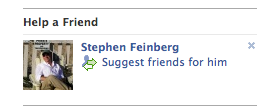
My daughter was kind/cruel enough to show me what popped up on her Facebook homepage last week:

I have no idea how many other zillions of people saw this. And please, no mercy friendings. I don’t want your digital pity.

Accidental truth in advertising.

Some advertisers get so twisted up in their own lies and are so tone-deaf that they wind up inadvertently speaking the truth.

Consider if you will the new campaign from United Healthcare. The theme line is “Health in numbers.”

Why would a managed-care organization ever say something like that? Are they insane? Did a bitter proof-reader or disgruntled studio person remove the words “is not” between “Health” and “in” after one too many denied claims?

Numbers, after all, are not the solution, at least not to the average person. Numbers are the f****** problem. Policy numbers, claim numbers, phone numbers, reason for denial numbers, annual cap on benefits numbers, and the ever-rising number you see on your paycheck every 2 weeks that gets paid out to maintain your coverage.

So did United Healthcare and its agency have a massive wave of contrition, and decide to confess the truth—that healthcare insurance has been reduced to a dehumanized, soulless algorithm?

I’m guessing no. I’m guessing they got clever. They decided to cleverly turn a liability into an asset in the grand tradition of Volkswagen and Benson &Hedges, and make “numbers” mean something good.
If you can choke back the bile long enough to dig into the advertising, you’ll see what I mean: numbers=size=leverage=data=more benefits for more people.

And just to make sure you hate not just the words but the pictures, they plaster numbers all over people’s bodies and foreheads, conjuring up everything from concentration-camp tattoos to UPC codes to some grim near-future dystopia where we truly are nothing but numbers.

But why quibble? Once they used the word “numbers” in the same sentence as the word “health”, they were screwed. Too clever by half, they went 180º from the truth and wound up being honest entirely by accident.

Santa or else.


SPOLER ALERT: DON’T READ IF YOU HAVEN’T WATCHED MAD MEN SEASON FOUR EPISODE TWO.

The haze of liquor and cigarette smoke that hangs langorously over Mad Men doesn’t obscure the piercing truths about our business that still have the capacity to hurt.

Last week’s episode, when the Lucky Strike client Lee Garner, a good ol’ boy and closeted homosexual (he had Sal fired in Season 3 when his advances were rebuffed) forced Roger to put on the Santa suit at the office Christmas party, it tore at my heart.

In a beauifully nuanced escalation, the client went from jovial “suggestion” to more insistent request to a chilling command. And it was made all the worse by playing out in front of the entire staff.

And by the fact that it was Roger.

Choosing Pete would have meant nothing. Steeped in self-loathing, Pete would have seen donning the Santa suit as an escape from himself, not to mention a career-enhancer.

Don? Wasn’t gonna happen. And Lee knew it.

Burt Cooper? He already plays the jovial fool.

No…to exert maximum authority and to inflict maximum pain, the client chose Roger…elegant, patrician, unflappable Roger. Roger, whose ties to American Tobacco go back a generation on either side. Roger, whose inherited relationship occasionally lulls him into believing he is something other than a vendor.

Put on the suit, Roger. Put it on so I can remind you of exactly where you stand in the order of things. Put it on for your wife, your partners and all the employees with their stricken expressions to see.

As I sat there and watched in sick fascination, my wife turned to me and asked if anything like that ever happened to me and my partners.

A highlight reel of slights and humiliations, verbal cuffings and inappropriate demands unspooled through my head.

Not that overtly, I said. But do some clients look for and exploit opportunities to make us choose between our dignity and our paycheck? Yes.

We may just have to put on the beard, or carry the sack, or bellow “Ho, ho, ho,” but it’s putting on the Santa suit, it’s still uncomfortable, and the alternative, the unspoken “or else” is still terrifying in its unknowability.

Spies like us.


With the ten Russian deep-cover spies safely in the hands of the KGB (and wishing they were back waiting in the checkout line at Costco), it got me thinking what good advertising creatives they’d be.

Great creatives are natural snoops and voyeurs. They are not Joe Sixpack, but they need to create beer ads for him. They are not Soccer Moms (well, most aren’t) but they need to sell them cookies, hand sanitizer, minivans and back-to-school supplies. They are not Seniors but they need to sympathize with their aches and pains and need for financial security. Most agency creatives are urban hipsters, frat boys, geeks, emos or some other strain of boho.

So what you have are these well-educated aesthetes living undercover…listening, observing, furtively turning on Fox, scooting in and out of Wal-Mart on the DL, trying to understand regular Americans and, via the ads they make, trying to become one with them.

Every Tide commercial you ever saw, every redneck ad about huntin’, fishin’ and racin’, was an act of subterfuge, carefully concocted by people who have spied on these worlds, but who are Other.

So when the Kremlin gets done “debriefing” you, you clever moles, you may want to think about putting together your books. Anyone who can put together that convincing a facade of American strip-mall consumerism is someone who can sell anything.

Alex Bogusky’s gone. I’m not.

http://online.wsj.com/article/SB10001424052748704525704575341131866209048.html

From what I gather, Alex Bogusky’s been getting out of advertising for a while..first the diet books, then the Dilbert-worthy move to “Chief Disruption Officer” at holding company MDC, and now peacing out for good.

What causes one of the best-known and most successful creative directors of the last 10 years to hang it up at the age of 47?
Is it boredom? After you’ve collected your 20th Gold Pencil and enough Lions to devour Siegfried & Roy, does the job of creative director seem pointless? What happened to the “My best work is ahead of me” mindset?

Lots of creative directors go onto 2nd lives that are more lucrative and maybe more fulfilling than their first ones. Look at Jim Patterson or Andy Spade or (heaven forbid) Donny Deutsch. But these guys never kicked ass creatively to the degree that Bogusky did, so it’s easy to imagine their needing to scratch the itch a different way.

Then there’s the whole sub-category of advertising copywriters who made the switch to commercially successful writers–Peter Mayle, Augusten Burroughs, Robert Goolrick. I don’t know about Mayle, but the last two worked for me at different times, and though very different people, have in common a healthy disdain for advertising, copywriting, and everything and everyone associated with the occupation.

They’re all gone, out of the business. Part of me thinks I should at least be curious about joining them.

But I’m not.

I want to keep doing this while I still have my wits about me. I like making ads. I like learning new ways to make ads. I like working with artisans–photographers, directors, editors, musicians–to make ads real. I get a ridiculous child-like thrill seeing my work, or the work of people I manage, go out into the world.

You’ll get my keyboard when you pry it from my stiff cold fingers.

Because "very small" didn’t sound right.

John Lennon’s handwritten lyrics. These are the “finished” words. The other side of the page has even more scratch-outs.

Sold at Sotheby’s on Friday for $1.2 million.

All out of proportion

Live sports, broadcast in HD, seen on a properly configured HD TV, is a visual treat. Watching commercials dropped into that broadcast: much less so. Last night watching the Yankees game I saw, in one commercial pod, the following:

–a spot letterboxed vertically and horizontally

–a spot stretched to fit 16:9

–a spot in 4:3 with vertical letterboxing

While TV manufacturers are busy hawking the next technology–3D–advertisers and their agencies and production partners are still coping with HD and widescreen.

Like Afghanistan, there are no good options, only bad and more bad. Consider: if you finish your spot in cinema (widescreen) 16:9, viewers with regular (4:3) TVs will see it horizontally letterboxed. If you finish it 4:3, viewers with widescreen TVs will either see it vertically letterboxed or stretched like Super Putty to fit the screen.

Wait, you say. Widescreen is here to stay, and so is HD. Maybe, but remember: that big beautiful 1080p screen needs to be properly configured and provided with HD signal. The first is beyond most people’s capability and the second is rarer than you think. Why do you suppose all those TVs in bars, gyms, banks and lobbies have their Fox talking heads all looking unnaturally wide (and Rush even more so)? Because no one set the controls. And all those Law & Order episodes cha-chunging away till for the rest of time? Low-def, baby.

The interesting thing (to me at least) is: no one outside the business even notices. First, because it’s a commercial break and who cares, and second, because in a world of Flips, grainy videos and 2-inch screens, production issues don’t matter much.

But take it from me: if you’re selling a weight-loss product, you do not want your client seeing her commercial with everyone in it looking like a double-wide trailer because it’s been stretched to fit the screen.

No thanks, I’d rather watch grainy video of oil gushing into the Gulf all day long.

I thought my last post would also be my last word on BP’s benighted ad campaign, because it’s hard to have an original take on something that every last man, woman and child on earth think is stupid.

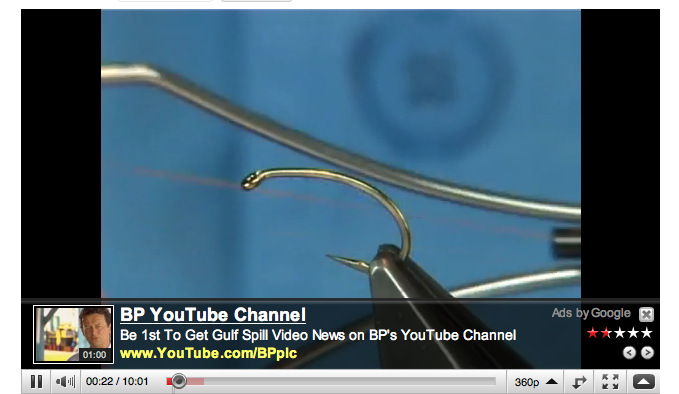
So instead, to take my mind off all the unpleasantness, I YouTubed up an instructional video on fly tying. I’d be walled off from all the noise, in my own fly fishing geekdom, and I’d be safe.

And then I saw this:

Never mind how frikkin’ ridiculous this is. If I wanted to watch BP CEO Tony Hayward lying through his teeth, I don’t need to go on BP’s YouTube site. I can watch the same clip, with better commentary, on Jon Stewart.

No, my question is: How did they find me? And why? It’s like one their tar balls washing up in an Indiana cornfield instead of a Gulf Coast beach. Does BP have so much money to throw at this ad campaign that they can afford to target the most obscure reaches of the internet? Is this ad also appearing on sex dungeon sites? Or Elvis impersonator sites?

BP: go aggregate Liz Cheney’s eyeballs. Leave mine alone!

I hate BP. But I hate myself more.


In an early post on this blog, I expressed some qualified admiration for the nuanced way BP approached the energy/environment discussion when its corporate campaign launched around 4 years ago.

Reading that post now, with BP trying to suppress pictures of dead animals and denying the sub-surface plumes clearly visible from space, I want to throw up.

But it’s not about me and my gullibility, is it? Let’s shift the discussion and think about someone with much bigger problems than mine. Let’s think about the person who has to write the ads running now.

Let’s imagine that it’s a guy (for no good reason other than to pick a pronoun).

He’s in his mid-30s, a Group Creative Director somewhere (they wouldn’t give this to a junior creative). He lives in Park Slope. He and his wife belong to a food cooperative. The only car in his life is a hybrid and has a Zip logo on it.

He thinks BP is a bunch of lying, Earth-despoiling wankers. But he needs this job.

Painfully, letter by gut-wrenching letter, he types out the words

We will get it done. We will make this right.

He stares at what he’s written. He looks at his fingers, at the keyboard. He is a marionette. He is a cockroach. He is only following orders.

His art director pops his head in. “Make sure it fits on 2 lines” he says.

Same shit, different accent.


I’m back from two weeks in Scotland and I’ve watched a good bit of British television waiting for the sun to set sometime after 11 PM so I could go to sleep. And that meant the chance to watch a lot of UK advertising.

I’m here to report that it’s fookin’ rubbish, as the Scots would say. Just as we Americans generally mistake an English accent for a sign of intelligence, we hear those same plummy tones in their spots and give terrible English advertising a free pass.

What’s remarkable is how the advertising in each category tends to suck more or less exactly as much as its counterpart in the States. Royal Bank of Scotland, which imploded more thoroughly than Citi or Wachovia and is now owned by the taxpayers, is running “real people” testimonials with the line “Here for you.” Sound familiar?

Jaguars and BMWs veer around hairpin turns in cool, desaturated, misty worlds devoid of oncoming vehicles to a trendy music track. Sound familiar?

An analgesic…can’t remember which one…was a cheesy problem/solution POS with a graphic demo showing the wonder ingredient rushing to “the site of the pain.”

Fairy Liquid (P&G’s UK version of Dawn) is doing a down-through-the-generations-mums-have-always-trusted-Fairy spot. Sepia to black and white to Kodachrome to today. Classic Procter twaddle.

Speaking of Procter & Gamble, they started this “If it works here, it’ll work there” business years ago. They even had a name for it: Search and Re-apply. Really. I know firsthand because I was always being asked to try the campaign that worked in Yemen or Uruguay or Chechnia back when I worked on P&G business.

And of course, depressingly, they were right, as they are about most things having to do with marketing. People are all the same. Blood pudding at breakfast instead of bacon doesn’t make for a different insight. It’s just a different part of the pig. The only reason for a global brand to do different advertising in each country is politics…keep the locals feeling empowered.

That’s why I want to laugh when I hear clients at focus groups in New Jersey (the world capital of focus groups) say that perhaps they should do more groups in Minneapolis or San Diego or wherever to get a more varied perspective.

Are you kidding? You can go to fookin’ Scotland an’ ye’ll hear the same bollocks, mate!