Welcome to WordPress.com. This is your first post. Edit or delete it and start blogging!
Belly of the Beast
Gotta write some more copy before I smash the state.
Author Archives: sfeinberg
The real 800-lb. gorilla
Eric Webber’s excellent recent post on the triumph of cheesy commercials like the Snuggie and ShamWow spots and the Cash4Gold Super Bowl ad highlight the difficulty of justifying huge production budgets, especially in these cash-strapped times. As Eric and his commentators pointed out, insanely expensive but crappy commercials like the new Bank of America campaign, financed on the taxpayer’s dime, don’t help.
But for all the talk about budget woes and ROI as the reason clients push back on pricey top-drawer production, there’s another factor that never gets discussed. Insurance-peddling primates aside, it’s the real 800 lb. gorilla in the room whenever clients and agency people talk craft and production value.
I’m talking about taste.
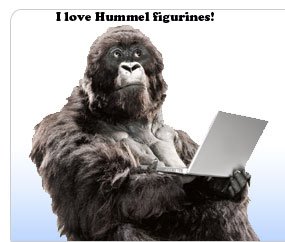
Or more properly, the lack of it on the part of many clients.
No one talks about taste because it gets uncomfortably into class issues and reeks of snobbery. It’s undemocratic and toally non-PC. There’s no “your taste” and “my taste.” There’s only good taste and bad taste, and neither correlates in any way whatsoever to people’s intelligence, character or ability. Some of the biggest jerks I know have impeccably curated and art-directed lives, and some of the finest people live in houses decorated by Wal-mart.
But nontheless, taste is real. Agency folk, and especially creatives–tend to have strong aesthetic sensibilities. They can be poor as church mice living in a 400 sq. ft. rathole, but it’ll be the best-looking rathole you’ve ever seen. If they own or wear anything tacky, it will be purely in an ironic way–the irony, of course, being lost on their clients.
Aesthetics is not a driving force in the lives of most American middle-class businesspeople. Work, family, community, church, sports, hobbies…these things come first. And because there is far more tasteless, tacky or just plain uninspiring stuff in this world than there is stylish, authentic and beautiful, the odds are overwhelming that the icky stuff will find its way into these people’s homes and wardrobes.

Nor is it about money. Check out this double-height shrine to bad taste:

Why does this matter? Because part of what you’re buying with a 1st tier director, music house, editor or photographer is his or her taste. Even if you’re lucky to work with a client with good taste (there are some), someone who understands what a Nadev Kandar or Noam Murro brings to the work, you’d be hard pressed to translate it into incremental business results. Now take a client who doesn’t even see the difference.
We all throw up our hands (or have Bob Garfield do it for us) when we look at Cash4Gold and see cheap sets, bad lighting, stilted dialogue and heinous graphics. A lot of clients (not to mention customers) looking at it say, “I’m sorry. What’s the problem?”
That’s the 800 pound gorilla talking. Good luck enlisting his help for your next production.
An annoying. Annoying. Annoying way. Way to. Way to edit.
Once upon a time there was Nike’s “If you let me play” spot. It was a beautiful commercial, and edited in a startling but ultimately logical way. The echoing words, plaintive and insistent, coming from the mouths and thoughts of young women of different cultures, ages and sports, became a kind of incantation.
Fast forward to now, where this editing approach is used constantly, and annoyingly, to try to give heft to spots devoid of interest. You see it everywhere, from cereal commercials to this new IBM campaign. “We need/we need to work smarter/work smarter/smarter” indeed.
And stutter less.
Ads from the Great Recession
Following the recent layoffs at O&M and elsewhere, there are maybe 32 people left to make ads for every client in the world during the Great Recession.
Some of these clients are staggering ahead, zombie-like, their ads suggesting they don’t know they’re actually dead and that the living are in pain. While Citi natters on about never sleeping, a concept that was novel in the pre-digital, pre-global, pre-ATM’ 70s but flat-out stupid now, ING is getting with the program by championing savings and the savers who save it.

Tiffany reacted with what I thought was tremendous speed (probably because they had this campaign ready to go for the Doomsday scenario currently unfolding) with their holiday ads talking about buying fewer, better things and gifts that hold value. Moral issues aside (and they are legion), this was clever thinking.
But I knew we were well and truly deep into the Great Recession when I saw a Gillette spot pleading with people not to re-use their disposable blades. Brother, can you spare a 5-blade Fusion cartridge?
Christmas Eve, 2008

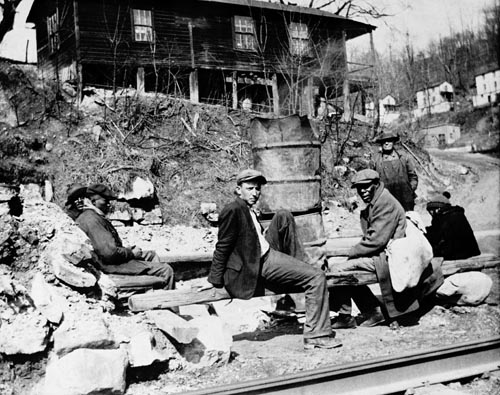
Today at 1:39 PM, the Great Recession finally reached me.
No, I didn’t lose my job. I lost a half-eaten roll that was sitting on the bar at the Bar Room of the Oyster Bar in Grand Central.
A homeless man walked through the seasonal crowd, spotted my roll, made a Citizen’s Appropriation and kept walking. The bartender, a young woman, watched in horror. “What the hell are you doing?” she asked him.
“Eating a roll” he answered logically as he sauntered out and into the Terminal.
“I’m so sorry,” she said to me, mortified, and then proceeded to put a fresh basket of bread in front of me.
Then it was my turn to be mortified. Mortified that I was feasting on oysters when this guy stole my roll. Mortified that I didn’t run after him and offer to buy him lunch. Mortified most of all that I still had an appetite when all was said and done.
It’s the season of giving, and giving takes many forms. The Talmud distinguishes 10 different kinds, and rank-orders them to boot. I don’t know enough about my own religion, or the one that celebrates Christmas, to know if inadvertent giving even counts.
How not to be right for the times.
If you had to choose between filling a prescription and filling your tummy, wouldn’t this cover make the choice ever-so-much easier?

I hear their hooves, I feel their hot breath.
Yesterday the New York Times reported hocking its own building for cash, the Tribune Company filed for bankruptcy, ad spending was predicted to decline 30% next year and an editor friend found out her editorial company was closing up shop December 31st.
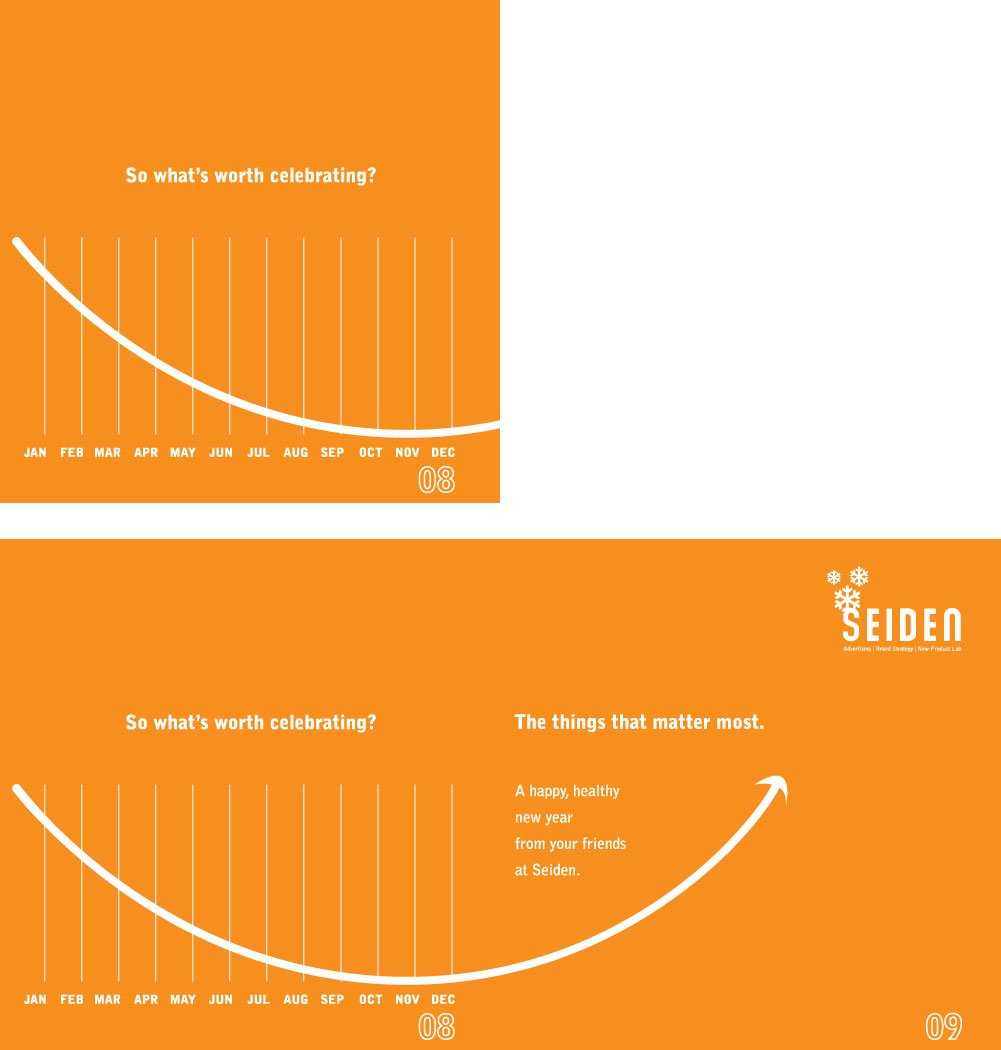
Bad mojo all around as the year slides into solstice darkness. I am incredibly thankful that our agency is healthy but the Four Horsemen of the Ad Apocalypse—Recession, ROI, DVR and Online Search—are approaching.
Before they get here, our agency’s holiday card is a propos:
My bumper sticker is better than your Cannes Press award-winning headline
Seen on on the bumper sticker of a car in front of me Friday:
Don’t believe everything you think.
Who are you going to believe–us or your own eyes?
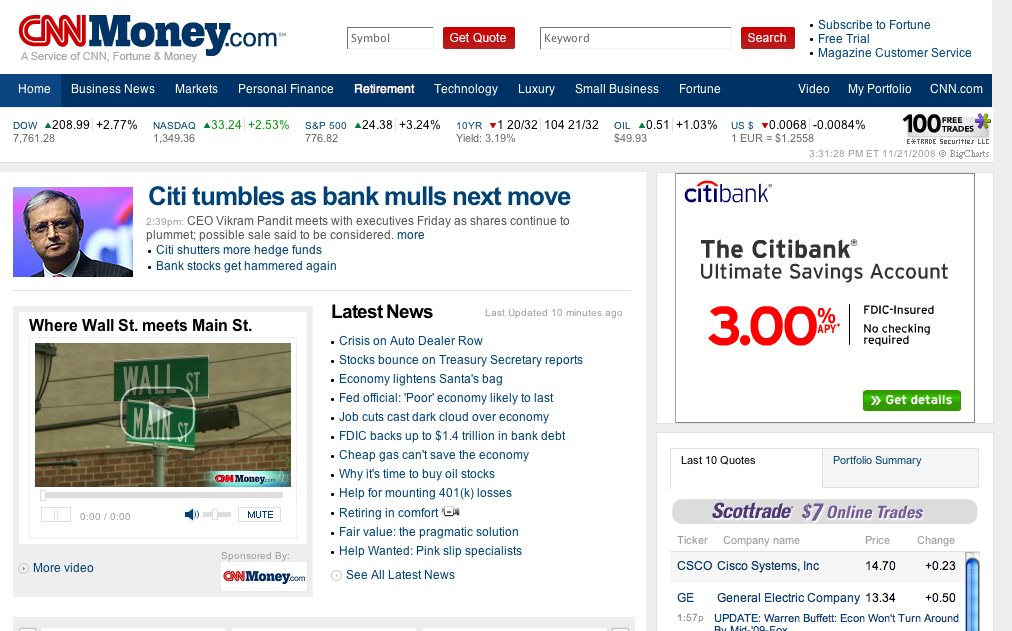
Seen this afternoon on CNNmoney.com
Where were we, anyway?
Oh…right…advertising.
Pretty hard to think about it, let alone write about it, until after the election.
But that didn’t stop Ad Age and Adweek from speculating about “what Obama’s win means for Madison Avenue.”
If it means anything, it’s that telling outright lies doesn’t appear to work as well as it used to. At least, not in the branded candidate space. But that’s getting a little macro. The election’s over. I haven’t felt the need to go to HuffPo or 538 for days. Let’s ratchet it back down to more day-to-day advertising issues.
Here’s one: having the advertiser you were the TV voice of, dive headlong into the crapper. Stockard Channing’s take on AIG’s demise as quoted in New York Magazine: “Guess they didn’t have the strength to be there.” Guess not. Hope she got all her residuals.
 Belly of the Beast