Author Archives: sfeinberg

The post-Yom Kippur, financial meltdown, possible End Times Remorse-fest

I am feeling remorseful.

Yom Kippur stirred things up, and then the disappearance of 30% of my life savings whipped it into a froth. Did I, in my own small way, help bring about this calamity by prodding people to buy things they didn’t need or couldn’t afford? And now, will I become more compliant about unreasonable client demands in my newly hobbled financial state? Can I afford to be principled? What does being principled in the ad business mean anyway?

For those of you wondering similar things, or who just like taking stupid self-diagnostic tests, here’s the First Annual Advertising Morality Gut Check Test. For each situation posed, ask yourself what you’d do, then rate your response on this scale:

1. What’s the problem?
2. I’d do it, but I’d have misgivings.

3. Only if you put a gun to my head.
4. I’d quit first.

There are no right answers, but if you keep answering (1) to everything, you obviously have the morals of an iguana. And if you keep answering (4) you’re either a Trustafarian or only 22. For the rest of us, most of the time, things are uncomfortably somewhere in the middle.


First Annual Advertising Morality Gut Check Test

For each situation, rate your answer from 1 thru 4 using this scale:

1. What’s the problem?
2. I’d do it, but I’d have misgivings.
3. Only if you put a gun to my head.
4. I’d quit first.


Using a parity claim like “No other brand gives you more” when you know people often take this as meaning superiority.

Selling a product that’s harmful to the environment, e.g., non-recyclable, containing harmful chemicals, using high amounts of fossil fuel.

Working on a casino or horse-racing account.

Working on a liquor account.

You’ve been asked by the client to get some “younger thinking” on his business than the two early-50s creatives who now work on it.

Working on a tanning-bed account.

Working on a tobacco account, including cigars.

You have the opportunity to pitch a piece of Wal-Mart business. You detest Wal-Mart for its refusal to sell birth control but willingness to sell guns.

Using fear or doubt as a selling tool.

Using sex as a selling tool.

Persuading people to use a brand you believe is inferior to the brand you use at home.

Your client is ready to spend a significant amount of money to launch a new product. The launch effort would represent a nice piece of revenue for your shop. You believe the product has no chance of succeeding.

Persuading people to ask for an expensive brand-name Rx drug when the cheap generic works just as well.

Working on Capitol One or similar accounts that promote easy credit.

A campaign on behalf of the coal industry.

A campaign on behalf of the mortgage-broker’s association.

A campaign about the health benefits of red meat from the National Beef Council.

You’ve been asked to pitch a sugary kid’s cereal. It would be a huge win for your shop. You have an overweight child at risk of developing diabetes.

It wasn’t me! It was the focus group!

Thanks, WaMu!

The morning after Washington Mutual was seized by the Federal government, I received the following jolly email:

Talk about CRM! They’re still looking to “deepen my engagement” after they’re dead!

They call this kind of graphics-loaded push email “rich media.” What do you call it when the sender is insolvent, I wonder?

Get me re-write!

I went back to the NYT fiction piece on Folgers online and saw to my excitement that the story had been corrected and updated–maybe they had gotten the credits and dates right!

Well….no. Here’s the correction:

Correction: September 22, 2008
The Advertising column on Friday, about a marketing campaign by Folgers coffee, misstated the type of coffee beans used by a rival, Maxwell House. It primarily uses Arabica beans, not the less expensive Robusta.

That’s their story and they’re sticking to it.


History is written by the victors. And reported by the lazy.


I was more than a little surprised to read in last Thursday’s NYT ad column that Saatchi was Folgers Coffee “agency of over 50 years” and that “…Saatchi & Saatchi created the campaign, as well as the “Best part of waking up” jingle, which first aired in 1984.”

No, and no.

Cunningham & Walsh was Folgers agency, in a relationship that predated the brand’s acquisition by Procter & Gamble. C&W created the “Waking Up” campaign before being acquired by N.W. Ayer, which became a part of D’Arcy which in turn was broken up and the P&G piece (including Folgers) wound up at Saatchi.

But who cares about this tedious chronology (besides those of us who were there)? Saatchi’s still here, and those other agencies aren’t. The Romans renamed all the Greek gods and claimed them as their own. Soviet-era history books deleted all mention, including birth records, of party apparatchiks who had fallen into disfavor. And today you can have a 30-year track record as a champion of financial deregulation and call yourself the Scourge of Wall Street.

As long as no one remembers and no one checks, you can, as Don Rumsfeld used to say, make your own reality.

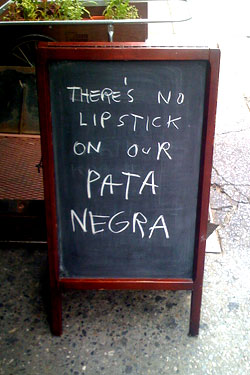
And the winner in the non-traditional media category is…

Thanks to Daniel Maurer at Grub Street, New York Magazine’s food blog, for catching this nicely opportunistic piece of copywriting.

Pata negra, as you may have guessed, is a breed of pig. Not an Alaskan variety, as far as I know.


Compared to what?


Watching McCain last night demanding regime change from the status quo when the status quo was standing right in front of him, got me thinking about comparisons.

Advertisers love comparisons, and with good reason: they work. Comparing your product to something else puts its worth in context. It’s what consumers do anyway–you’re just helping them along.

Less sophisticated marketers do literal and heavy-handed comparisons to branded competitors, accompanied by lawyered-up copy and disclaimers, and consumers hate them for it. Even the incredibly deft Mac/PC ads get their share of blowback from people who consider them mean-spirited. (BTW–it’s amazing to me no one’s done the Obama/McCain version of these spots..it would seem like a YouTube no-brainer…)

But the most sophisticated marketers, like P&G and some (largely Republican) political strategists, have grasped the deeper, more insidious truth:

It doesn’t matter who or what you compare yourself to, as long as the comparison is in your favor.

Years ago, I worked on P&G’s Puffs Tissues business. The client was absolutely insistent on a side-by-side demo in the advertising for their “new and improved” product, even though Puffs had no visible, demonstrable difference vs. Kleenex. We didn’t even have a good comparison to the older, “unimproved” version of Puffs. Finally, the R&D folks at Procter pointed out that Puffs were, in fact, puffed up with air as their final step in manufacturing, so why not compare them to the unpuffed (that is to say, the unfinished) version? The result: a visual of a stack of Puffs towering over a sad short stack of unpuffed Puffs. And of course, it worked like a charm.

John McCain’s handlers hope the same will hold true with their candidate. Comparisons with Barack Obama are not necessarily advantageous, so why not use the departing administration, which very nicely fits the “big-spending, me-first, do-nothing” requirements, as the foil? Who cares if they’re Republican? They’re un-Puffed!

Thanks to AD Kim “Crazy Fingers” Magher for the Photoshop work.

Location, location, location

Seen on the corner of Bowery and Spring Street yesterday:

Bet the Carerra sunglass people (the advertiser on the left–sorry for the crappy phone pic) didn’t see this one coming, so to speak.

This kind of unfortunate message juxtaposition happens more often than you’d expect, in every medium. So much so that you might wonder whether some bored junior media folks are doing this for laughs after huffing a few spray cans.

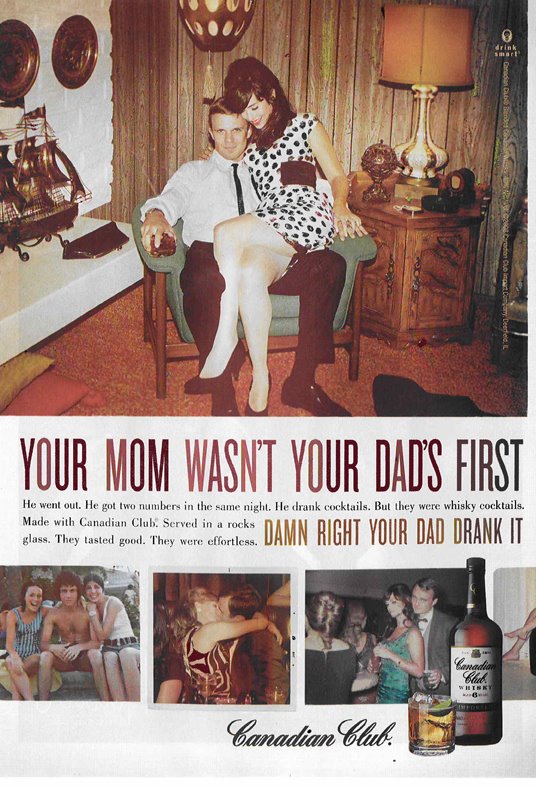
Hats off, and bottoms up.

The brief (I’m guessing) said leverage the brand’s history and heritage but make the advertising “edgy” and relevant to drinkers in their 20s.

Most creatives would say, with some justification, “We can do one or the other but not both.”

These creatives did this: (click on ad for better view)


Pure genius.