Category Archives: Uncategorized

If, It, whatever.


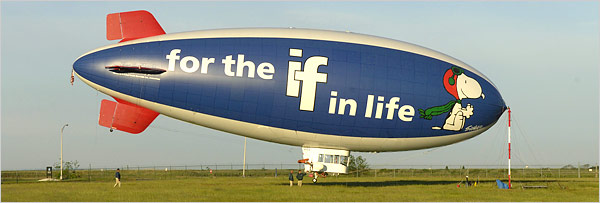
Has anyone else noticed the remarkable resemblance between Met Life’s new “If” campaign and eBay’s “It” work?

Squint slightly, or have a couple of mojitos, and the two ads will appear identical…each with two giant, Stonehenge-like letters dominating the page.

Seems to me they’d be better off swapping, though. Wouldn’t Met Life rather be about “it” than “if”? So much more certain-sounding. And wouldn’t eBay’s serendipitous nature be nicely captured by “if”?

I’m sorry, what was the question?

An ad currently running for the Lexus ES starts off with this headline-as-question:

“Is it possible to engineer desire?”

I’m guessing the answer they’re looking for is yes– even though the copy never says so–and that the Lexus ES is proof. Well, fine, this wouldn’t be the first car ad that tries to juxtapose emotion and science, heart and steel, etc etc etc.

But that just makes this execution derivative.

What vaults it past derivative to silly is that question mark. It’s that school of thought that says “Don’t just tell people things. Ask them instead—it’s more involving.” Ask the right question–Allstate’s “Are you in good hands?” comes to mind–and the effect can be unsettling…or illuminating…but never boring. But ask the wrong question and the opposite happens. What better way to signal you know nothing about me and don’t care to learn than to ask me a question I see no reason to answer? Here’s another example, for a new Canon DSLR:

“When Canon created the new EOS 30D, what were they thinking?”

I don’t know. I don’t care. But what was that copywriter thinking? That the implied meaning—Canon’s done something terrible, Canon’s gone off its rocker—would give this ad a frisson of danger?

Lawyers have a sacred rule when it comes to courtroom witness examination:
Never ask a question you don’t already know the answer to. The object, obviously, is to maintain control, avoid surprises and keep a witness from going in an unproductive direction.

Copywriters might consider a different rule: Never ask a question if people don’t care what the answer is.

How to be a better client.

There’s an old saying in this business that clients get the advertising they deserve. Here are some things they don’t teach in business school or discuss in marketing conferences that can increase the odds you’ll get your agency’s best efforts–and deserve them.

Don’t buy a dog and then bark for it. The reason you hire an ad agency is because their people can do things you can’t. Tell your agency team what your advertising needs to do, agree on how you’re going to measure it, then let them work. Telling advertising professionals how to do their job wastes their talents and your company’s money.

Value our Otherness. While an agency needs to understand its client’s culture, business model and products, they are not you. That difference is valuable. There’s already an expert on your company and its products and it’s you.

Be straight with us. All companies have politics. All employees have bosses. If either one is the reason you’re reluctant to embrace a good idea, tell us. We will respect you, empathize and work with you to deal with the problem. If you don’t tell us, we’ll have no choice but to think you don’t know a good idea when you see one.

Do not ask: Is there a better shot/take/word/phrase/layout? The creatives don’t think there is, or you would have already seen it.

Get out from behind the glass. You’re a successful young professional. Living someone else’s life, even for a few minutes, beats watching it every time. Go to a NASCAR race (not comped). Watch Fox. If you already watch Fox, listen to NPR. Walk around a neighborhood you don’t know. Eavesdrop, always. And whatever you do, when looking at the agency’s work…

Don’t think like a marketer. You were born with all the training you need to look at an ad and figure out if it’s good. Your humanity and your life experiences will steer you right. The minute you start analyzing, you’re in trouble.

Nothing claims better than…a claim.

All the shit that used to work
Don’t work now.
–Warren Zevon, “My Shit’s Fucked Up

What is it about claims? What is the power of its siren call to clients of all stripes?

Why must everything be stronger, longer and preferred 3 to 1? How is that even possible? Some advertising domains, like wireless phone service, automotive and analgesics, seem to inhabit a parallel universe in which the laws of statistics don’t apply—everything’s above average, like Garrison Keilor’s children of Lake Woebegone.

Back in the day, claims were the backbone of that package-goods stalwart, the Reason To Believe. They were a mashup of engineering and marketing, written to make sense to civilians but still trailing their cloak of numbers and percentages from the lab. And mostly, they worked.

So the claims-driven model was exported out of the world of detergents into other arenas, often with bizarre results. I remember a Procter & Gamble client in the early 80s, during a brief, unhappy period when the company was dabbling in the soft drink business, telling me excitedly he had data to support the claim that Orange Crush was preferred to Coke by Coke drinkers.

Never mind that this was an oranges-to-cola-nuts comparison, or that if it actually mattered, Crush’s market share wouldn’t be one hundredth of Coke’s. No, this finding demanded an enthusiastic Damn-let’s-run-with-it! kind of answer.

“So?” I asked.

Not the best response, but what was true then is (here’s a claim for you) even truer now. Maybe forty percent more!

Now that anyone (assuming they cared to) could get 2 zillion user’s ratings, expert opinions and blog reviews to compare to a company’s stated claim with one mouse-click, “Nothing works better” doesn’t work as well as it used to. You say you have fewer dropped calls? That’s not what CNet says! Or Jacko in the mycellphonetotallysucks.com chatroom.

I’m using wireless service providers as an example partly because an article in the New York Times last week pointed to one reason why old-fashioned claims still make%

Rich off our backs! Wait–we are rich.

You know the guy you meet at your 25th college reunion who forces you through a Bataan death-march of reminiscences you don’t actually share?

“Hey man, remember that killer Michuocan bud we scored before the Jethro Tull concert? Or how about when I puked on your stereo during Homecoming? Good times, man, good times.”

You don’t actually remember any of it because that guy wasn’t really your friend in college—he was just some hanger-on looking to score free dope or pizza. You didn’t like him then and you don’t like him now.

That guy—let’s be frank: that asshole—is back and on our TV. The same bogus memories of shared psychedelic adventures. The same thinly disguised taker’s agenda. Except now he’s called Ameriprise.

Whoever created this disagreeable mess, shame on you.

Shame on you for thinking that showing me a ripomatic with clips from Woodstock, pictures of Che and kids with bad hairdos would induce me to roll my 401K into your outfit.

Shame on you for tarnishing images and music I associate with not caring about money with talk of wealth management.

That was then, this is now. Part of me never left Woodstock, but dude, I don’t remember seeing you there. And besides, I don’t want some stoner investing my life savings.

Cooties.

For the few of you who read this blog with any regularity, my apologies for the lack of new postings.

I’m trying very hard to keep this thing from devolving into an Apple-hating rag, but a hard crash on a Unix-based system, while rare, is not a pretty sight. My spiffy new Intel-chip based MacBook Pro dove off the deep end last week and only emerged, functional but with a slight case of amnesia, this morning after a thorough scrubbing.

This new platform is a buggy little bastard, a lot less together in reality than the hipster holding hands with the PC dork in the new Apple spot. Many perceptive writers have already pointed out that this campaign is one of Apple’s periodic returns to Kool-Aid drinking.

In the commercial, it’s the PC that gets cooties. But if the dude/computer he’s holding hands with is an Intel Dual Core-based Mac, he better wash his hands but good.

P.S. Armando, my muy macho I.T. dude, says don’t install the OS 4.6 patch, whatever that is, in case you were thinking about it.

P.P.S. Yo, Apple: the switch-testimonial commercials directed by Errol Morris were the best Apple computer advertising ever. Make some more of those. If you run out, just run the stoner-girl one again.

Hot Pants!

This is supposed to be a blog about the making of ads, but since Macs are the computer of choice for 99.99% of creatives, let me put this out there:

Mac laptops run hot. Fry-your-thighs hot.

Apple was supposed to address this issue with the new Intel-powered laptops but as the proud owner of one, let me tell you: mission not accomplished.

So here’s a product idea for someone to implement. I claim no intellectual rights. Make a thin, portable pad with high insulating qualities I can put between my MacBook Pro and my parboiled legs. I’ll love you for it and so, I suspect, will a lot of other copywriters.

Insert visual pun here.


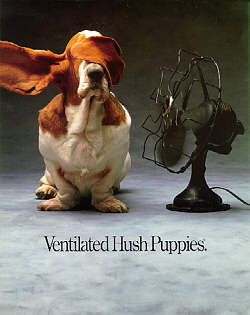
I think it all started with Hush Puppies.

In the late ’80s, Fallon McElligott (yes, boys and girls, it was not always just Fallon) created a great campaign for the hopelessly dorky shoe brand in which an appropriately-propped basset hound stood in for whichever style was being featured.

(For a nice article about the genesis of this campaign, click here.)

But this approach—the visual pun—has, in the succeeding two decades, spread over and overwhelmed the worldwide advertising landscape like conceptual kudzu.

Open any issue of Archive at random and you’ll see ad after ad featuring a visual pun riffing off the brand name or the product’s function. In the lower right hand corner (often cropped to bleed off the page) is a logo or pack shot, sometimes coupled with a numbingly self-evident line of copy like “Kills Bugs” or “Sexy Lingerie.”

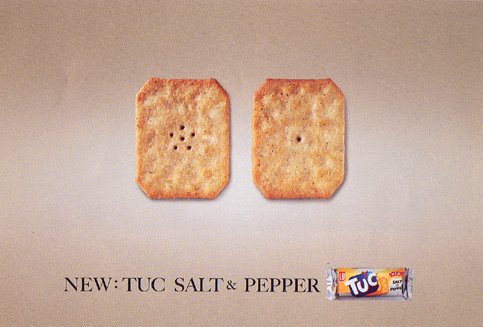
Here’s a recent example from the current issue:

If you break this ad down, it is structurally exactly the same as the Hush Puppies ad. Portfolios coming out of the ad schools are just filled with layouts like this, no doubt because they tend to do well in the shows.

Many of the same young creatives who would gag and roll their eyes at 70s-era verbal puns (“A fresh approach to frozen peas”) think Photoshopping an insurance-company logo into the shape of a down comforter is kick-ass creative.

Puns, whether visual or verbal, are what they’ve always been: a lazy man’s way out. They require no understanding of the product or the people who might use it, substituting glibness for soul.

Except.

I can think of two good cases for exception. The first is when the pun lets you say something you can’t—or shouldn’t– say straight up. The Hush Puppies work is a good example of this. Does anybody want see the literal version of ventilated shoes at work?

The second is when you’re not allowed to say anything. The long-running British Silk Cut campaign was a brilliant solution to this problem (it may actually pre-date the Hush Puppies work, and therefore be the Mother of All Visual Pun Campaigns).

These situations aside–and there aren’t that many of them, really—thinking of how your ad can be of some value in the world usually leads to better, more original work.
Slogans than don’t suck (1)

Can we just all stop for a second and bow down to whoever wrote
“When banks compete, you win” for Lending Tree?

It is a small miracle of copywriting.

First of all, it boils down a complicated process—a reverse auction in which financial vendors review your online credit application and credit history and generate a loan offer—into five words.

In the same five words, it makes it clear what the benefit is to you.

It’s written in perfect iambic meter, the da DUM cadence rolling right into your brain.

And it’s pitch-perfect in tone, neither overselling or underselling.

Gems like this don’t get much recognition in awards shows, or in creative circles in general. Lines or slogans are increasingly viewed as hopelessly passé, an afterthought for the client.

But even in this post-literate age, a well-crafted line is a meme not be trifled with.

Copywriters: there is no shame in the writing of a good slogan, even if there is no glory.

Clients: when your line rocks, you win.

Apprentice Admakers

Am I the only one who thinks a suspiciously high number of the tasks on “The Apprentice” involves coming up with ads?

One week it was to shoot a tv commercial. Then it was a print ad. Then a large outdoor poster.
Donny Deutsch was a judge. Then Linda Kaplan Thaler. Then Donny again. Then some clients.

And the work! Crazy bad. A couple of weeks ago the task was to come up with an outdoor billboard for a new cereal. The winning “idea” was a woman in a track suit gulping cereal out of the box. Don’t ask about the loser.

But what can you expect?

As I said in my last post, when clients think creating advertising requires no special skills and agencies do little to dissuade them, you get little apprentice admakers “concepting” for five minutes and some poor wretch in the bullpen at Deutsch comping it up for viewing.