Category Archives: Uncategorized

Mmmm…sketchy.

Not a super-big deal, but:

Has anyone else noticed that the Quizno’s spots have 4 “Mmms” on the title card but five in the AVO track? Dos being one “M” short make them somehow less toasty?

So much for audio-video sync.
Or maybe I should just get out more.

Separated at birth?


This is not supposed to be a political blog, but take a long look at these two pictures.
The close-set eyes. The eyebrows. The nose. The thin mouth barely supressing a smirk.
Every wonder why you don’t see these two guys in the same place at the same time?

September 12th.

Everyone has their own way of commemorating events.

Yesterday I bought a lamb gyro for lunch from the cart guy on 45th off of 3rd. He’s Egyptian. He asked me if I wanted hot sauce and I said, no, can’t take the heartburn anymore. He nodded sagely and said, “Like me. We are too old.” He gave me extra white sauce to compensate. I laughed. He laughed. I walked back to the office with my gyro, looking at the robin’s-egg blue sky—same as it was five years ago–loving New York and feeling hopeful.

Waiting for the light to turn, I watched a panhandler work the passing crowd. “Spare change? Spare change? How about a fucking penny? Can’t any of you motherfuckers spare a fucking penny?

Now that’s copywriting with attitude, I thought. And, this being New York, it was working.

Whatever you do, don’t talk.

This morning’s Stuart Elliot column in the NYT is grisly/funny evidence of what happens if you try to talk about advertising to journalists (even careful, knowledgeable ones like Stuart). You wind up saying things like this:

“I didn’t pop my head out of a focus-group room in 6 weeks.” And: “This audience doesn’t want to be advertised to.” (Others do?) And besides: if this audience has a particular loathing for advertising, grilling them in focus-group rooms for six weeks about which “concept” they like will teach you what, exactly?

This: “[This audience] doesn’t want to be told what to do. ‘Free to be’ says ‘you can be anything you want to be and you’re welcome at the CW.’”

(“Free to Be,” by the way, is the CW network’s new theme/strategy, and is yet another great instance of David Nottoli’s Tyranny of Consumer Insight point discussed in my last post.)

I have this vision of this guy’s PR handler sitting in the office, pleading with his eyes for the guy to stop, please stop, omigod please stop, while Stuart calmly sits there, writing down these bon mots verbatim.

Because here’s the deal: talking about advertising to civilians makes you sound like an idiot. That doesn’t mean that advertising is idiotic per se, although all manner of stupid things are said and done in our business every day. It just means it doesn’t translate well to people who are not compelled to drink whatever flavor of Kool-Aid you’re chugging.

While talking about advertising can make anyone look like an idiot, it seems to take its heaviest toll on client marketing execs like this guy from the CW network. Creatives, in general, are too introspective and paranoid to say anything ridiculous, although the ECD on this CW campaign waxed pretty poetic about the color green in the same article. Senior agency account managers don’t want to commit career seppuku by being more quotable than their client.

So that leaves poor Mr. or Ms. Sr. VP-Marketing to tell us why their new ad campaign will rock our world. Some cautiously opt to utter something unoriginal like “We felt we needed to cut through the clutter” in order to try to at least containthe damage.

For those desiring to go beyond the old clichés, the temptation is to put on that new-media-pioneer hat: “We wanted to find innovative new ways to engage our consumer” etc. etc.

And if that’s too tame, you can actually try to explain, as the hapless guy from the CW did, why your new advertising is a great idea. But if I were you, I wouldn’t. Nothing good can come of it.

Instead, I would do what generations of creatives, faced with the absurdity of articulating why they picked this typeface or that color, have done: gesture to the layouts or the roughcut or whatever, and say:

I think the work pretty much speaks for itself.

Garbage in, garbage out, garbage all around

Sidewalk Life: The Tyranny of Consumer Insights

David Nottoli makes a dead-on observation in this post from his excellent blog. For any creative who ever wondered why the briefs for the new deodorant, the online banking service and the fast-casual restaurant chain all have the same consumer insight, this is why.

63%? I’ll take it.

Advertising Age – New Book Reports 37% of All Advertising Is Wasted

Well, I know everyone is riffing off this news as confirmation of Wanamaker’s old crack about advertising, but for Chrissakes–63% of advertising works? I’ll take it.

30% gets you to the Hall of Fame in baseball. Success of new product introductions? Around 10% or less. Marriage success rate in the family-values lovin’ U.S. of A is around 50%.

Think about it: 63% of all the ads you see–mere images and words about foot odor and insurance and hamburger joints, competing for your attention with other unsought commercial messages as well as whatever content you’re actually trying to look at or read…do what they’re supposed to do.

If our industry wasn’t so drenched in self-loathing, we’d view this as vindication, not embarassment.

I know nottink!

I’m guessing that Dieter Zetsche is smart, down-to-earth and charming in person. I’m also guessing that becoming his company’s spokes-mensch was not his idea.

But turning him into an alternately terrifying and clownish Teutonic tool—whose idea was that?

Sometimes, the best thing a creative can do for the work is to just get the hell out of the way.

It’s not easy pretending to be Green

What is it about doing “look how green we are” corporate ads that drives companies to make up ridiculous terms for what they’re doing?

First GE came up with “ecomagination,” which, given the company’s history with PCBs in the Hudson River, must mean “our imaginary ecological commitment.” Or maybe it means “it takes a hell of an imagination to call our coal-mining technology ecologically sensitive.”

Now Honda is jumping in with “enviromentology.” So silly—and so unnecessary, because Honda has been a leader in fuel efficiency and cleaner emissions for decades.

Curiously, the copy leads off with some belligerent noise about preferring to let the company’s actions speak for themselves rather than just writing about it. But, ummm, you are writing about it.

Here’s a thought: rather than “enviromentology” and “ecomagination,” why not just call it what it is: trying to do the right thing.

I say “trying” because the dominant color when it comes to balancing a company’s roles as profit engine and corporate citizen is not green. It’s gray. The trade-offs are complicated and the win-wins are infrequent. And I say this as a spotted-owl-kissing, dam-blowing, Nature Conservancy-giving greenie.

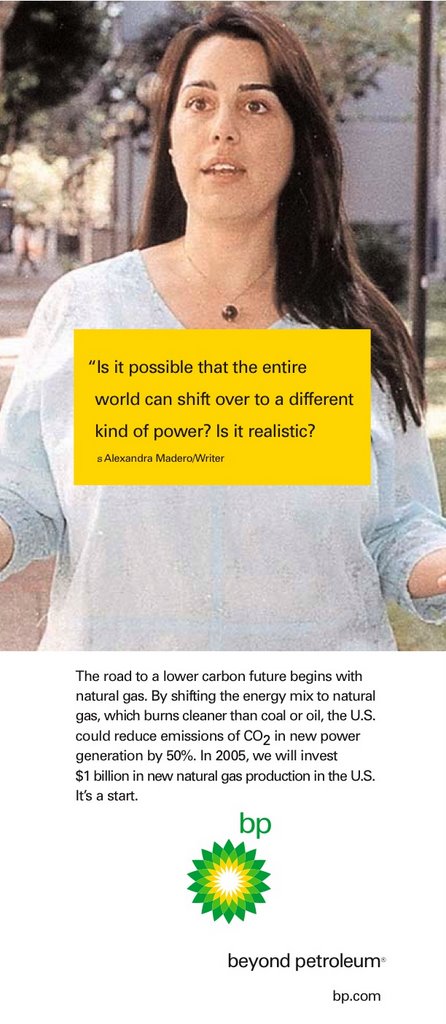
That’s why I respect BP’s take on environmental issues and responsibilities. It’s full of nuance and shades of gray (even when they highlight the buzzwords in yellow), and notably short on easy answers. I think they’re trying, and that—not an overactive ecomagination—is what counts.

A different kind of cool.

A week spent flyfishing in the Canadian Rockies empties the mind of most thoughts about advertising. Which allowed this thought to find its way in:

We coastal sophisticates use irony to keep an emotional distance and to avoid embarrassing displays of enthusiasm and happiness.

Southwestern Alberta, however, is a 100% irony-free zone, and it’s like breathing pure oxygen—utterly refreshing and slightly giddy-making. So how do flyfishing guides, who are among the coolest people anywhere, keep their cool in the face of jaw-dropping scenery and 24-inch trout?

Understatement.

“Pretty nice sky, there, don’t you think?”

“Decent fish you got there.”

We in the ad business could use more understatement and less irony. Is the advertising world ready for “Introducing a new truck that’s not half bad”?

I don’t know. But we’d feel better. We’d be less ironic. And we’d be a whole lot better-liked.

The arc.

Agency-client relationships have an arc, just like movie plots and short-lived romances. The arc typically has five points:

Admiration.
Infatuation.
Habituation.
Alienation.
Termination.

Let’s look at each one, and for you agency young ‘uns who haven’t traversed a full arc yet, don’t despair. Sometimes these things can stay at Habituation for years.

Admiration. The client starts to hear about a new shop. Maybe he reads a trade magazine article. Or he meets the creative director. Or maybe he sees an ad he likes and tracks down the shop responsible. Whatever. He goes to the agency’s web site and likes what he sees. He asks around and likes what he hears. He googles the agency’s principals. He finds himself daydreaming about working with this new shop. His current shop doesn’t know it yet, but they’re toast.

Infatuation. With or without the pretense of a review, the client has consummated his relationship with the new agency. The people–they’re so bright and shiny and new! And their ideas—so bold! Their media plans—so nontraditional! Where have these people been all my life? And the wrap party for the anthem spot? Dude!

Habituation. He can’t remember exactly when. It was such a gradual thing. One day, the process was a smoothly-running machine. Everyone on the same page, deadlines all getting met. The next day: a kind of comfortable boredom. Business as usual. Not in a bad way—we’ve got a total Vulcan mind-meld going. But do the senses tingle? No they do not.

Alienation. If the client saw one more podcast-driven idea, he was going to scream. The art director’s piercings were no longer exciting—they were tiresome. The Account Supe’s verbal tics—were they ever endearing? He thinks maybe once. But not now. Every flaw, every glitch seemed to be magnified, like zits in a make-up mirror. And that franchise meeting where the new campaign was shown? What a nightmare!

Termination. What was the name of that agency the West Coast sales manager was talking about last night? They sounded kind of cool. Wonder what their site looks like.
Wow. Very cool. Wonder if this is the right time to make a change?

That’s right—it’s the Great Circle of Life. One agency’s alienated client is another agency’s smitten stalker.