Category Archives: Uncategorized

Get me re-write!

I went back to the NYT fiction piece on Folgers online and saw to my excitement that the story had been corrected and updated–maybe they had gotten the credits and dates right!

Well….no. Here’s the correction:

Correction: September 22, 2008
The Advertising column on Friday, about a marketing campaign by Folgers coffee, misstated the type of coffee beans used by a rival, Maxwell House. It primarily uses Arabica beans, not the less expensive Robusta.

That’s their story and they’re sticking to it.


Hats off, and bottoms up.

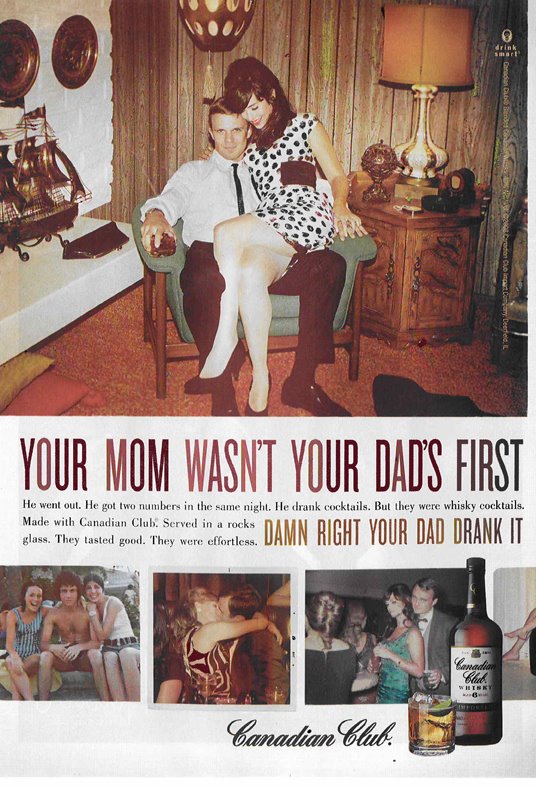
The brief (I’m guessing) said leverage the brand’s history and heritage but make the advertising “edgy” and relevant to drinkers in their 20s.

Most creatives would say, with some justification, “We can do one or the other but not both.”

These creatives did this: (click on ad for better view)


Pure genius.

Words matter. Ask any fishmonger.


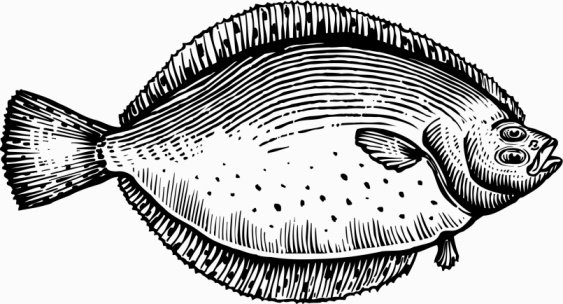
A few nights ago I had a hankering for fish and stopped by the fishmarket on the way home. I was looking for fluke, which is cheap, fresh and local in New York this time of year.

I saw grey sole, lemon sole and something called flounder. But no fluke. I asked the manager if he had any. He pointed to the filets labeled flounder and said, “That’s it. But I can’t call it fluke. Customers don’t know what fluke is. They think it means mistake. I call it flounder, I sell 30 lbs. a day. I call it fluke, I sell maybe 5.”

How often, when we make ads, do we try to “educate” people on what fluke is, rather than using terminology they understand ?

Being the client.


I’ve been in post-production mode for the last couple of weeks…working with editors, sound-design folks, composers, mixers etc.

I love this part, because I like collaborating with, and just hanging out with, talented people who know their craft. But that collaborative thing only goes so far. Because as far as they’re concerned…

I’m the client.

Most of the time, I can pretend that’s not true. We’re just a bunch of cool people doing our thing, right? But then I realize no one ever outright contradicts or even challenges anything I say, no matter how inane. I make casual suggestions and they get turned into new versions, posted at midnight.

This state of affairs makes me uncomfortable.

I’ll twist myself into knots talking to, say, the music composer. I’ll tell him I like #4 but could the back end be more like #2—understanding, of course, the need for the composition not to be a Frankenstein and feel integrated and my not wanting to be overly prescriptive and by the time I’m done apologizing and demonstrating my creative sensitivity, he’s already done it.

Because for him, it’s no big deal. For me it’s, Oh my God, I’m talking like a client. I’m fucking this guy’s work up. I’m taking his Juilliard training and stomping on it with my troll-like client feet.

This behavior spills over into non-work related relationships, particularly into fly fishing. If I go out fishing with a guide, my goal is to be the best client possible. Or at least not to be the asshole he curses out and ridicules later that night at the bar where all the guides hang out.

This is pathetic, I’ll be the first to admit. But I’d also be willing to bet I’m not the only person in a creative field dependent on clients that feels this way. I bet there are plenty of architects, clothing designers, game developers, as well as copywriters and art directors, who say to themselves, when the tables are turned and it’s their money and someone else’s talent:

Do not do to them what others have done to you.

Why CMOs keep getting fired.

The Kelly Award winners book came out last week, with a lot of nice ads, including a bitchin’ campaign for Oral B dental floss. An ad which I doubt ever ran except maybe once in Dental Floss Gazette because nobody, not even BBDO, can talk P&G into buying a 2-page spread to advertise dental floss. Without a word of body copy.

But I digress. All award shows have fake ads. But this award, like the Effie, is supposed to be tied to business results. Which is a bigger opportunity to game the system than submitting ads that never ran.

The “Results” for the Oral B campaign, just to pick one example, were described this way:

Exceeded awareness goals.

When did awareness become a business goal for a 100-year-old brand?

Here’s another squishily soft result, for Liberty Mutual’s “Responsibility” campaign:

Improved attitudes toward brand by 9%.

I love this campaign. It actually manages to find common ground between the needs of the insurer and the needs of the insured, which is no easy feat. And it’s beautifully executed (the TV and online even more than the print). But “improved attitudes toward brand by 9%”? That’s a pretty low performance bar since you’re starting from 0% approval. (It’s insurance, remember?)

Speaking of low bars, Duncan Donuts’ campaign to launch a new line of Smoothies purportedly boosted weekly sales 250%. Pretty impressive result until you reflect upon the fact that this is a new product introduction. So the weekly sales results prior to launch were…zero.

I wouldn’t want to explain these kinds of results to my CEO if he or she had half a brain.
Is it any wonder CMOs have the life expectancy of a mayfly?

Reduce. Re-use. Recycle. Or just shut up.

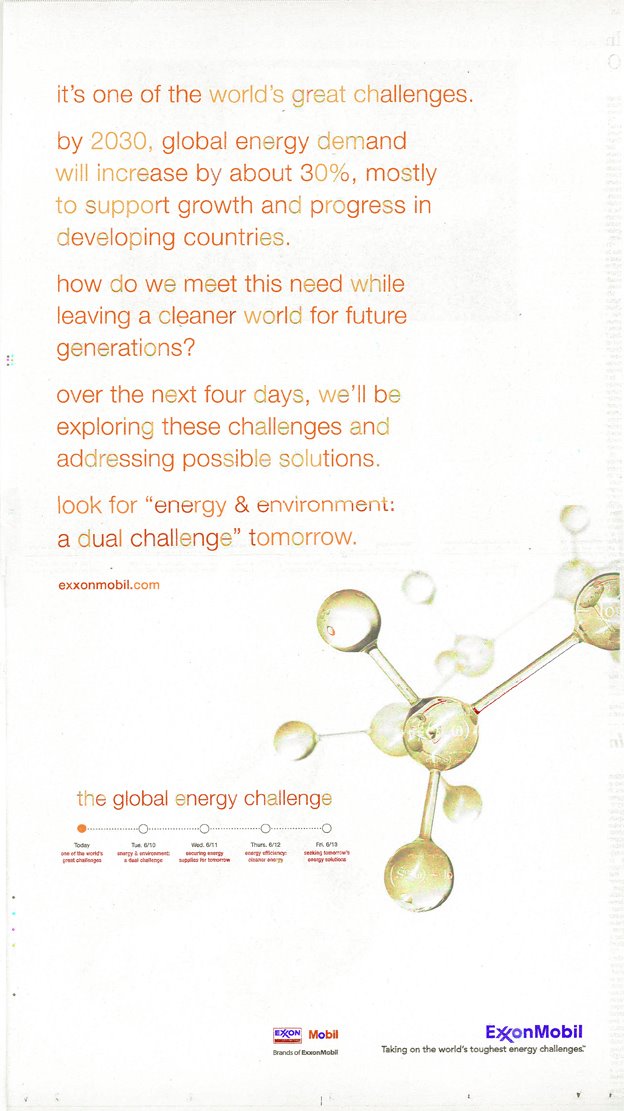
Big company. Big PR problem. And in response…big, big full-page NYT ad.

Texas big. Hummer big. Forest-depleting big.

You want to run an ad campaign trying to convince people you’re not the environment’s worst enemy?

Run smaller ads. Fewer of them. Use them over again before you make new ones.

Don’t worry—no one will get bored. No one’s reading these ads any way.

Or take the media buy and fund alternative-fuel startups.

Slogans that don’t suck (2).

I didn’t realize how much I liked Reuters’ old line “Before it’s news it’s Reuters” until it was scrapped after the Thomson acquisition.

Let’s parse it for a moment, shall we?

First of all, there’s a clear benefit: timely information. Any more timely and you’d probably wind up explaining yourself to the SEC.

Then there’s the lovely Iambic rhythm to the phrase. And the neat parallel construction of the It’s/it’s.

This line didn’t matter much when it ran, because Reuters was about attracting advertisers, not being one. it matters less now that the company has been bought.

But that line was good craft, and I really need to believe, in a life-or-death kind of way, that good craft always matters.

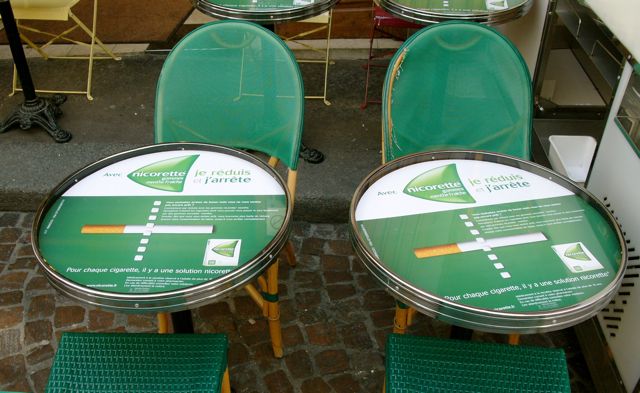
Fumer, non. Publicite, oui.


Seen at a cafe in Paris. Pretty good use of an unexpected medium.

Citi redux, reduxed.

Citi’s New Slogan Is Said to Be Second Choice – New York Times

Well, “Let’s get it done” is…done.

As I predicted it would be in my post of almost exactly a year ago. Allow me to quote from myself:

“…Citi’s dead-man-walking CEO Charlie Prince wanted to put his own stamp on the company’s image. In this derivative, clueless effort, he has succeeded wildly….When Sandy Weill comes back to rescue Citi from his own anointed successor, I’ll bet anything that “Let’s get it done” will be done as well.”

Well, I didn’t get the Sandy Weill part right. Turns out Vikram Pandit played executioner instead. But no matter.

The new line? An old line: “The Citi never sleeps.” One can debate how differentiating that is in a world of ATMs and online banking (a world Citi pioneered), but it’s literally true in one sense: with call-center reps largely based in Bangalore, they’re definitely wide awake at 3 AM.