Part of a series exploring financial opportunities in calamity. Other executions include one on monetizing Darfur relief efforts, and an ad whose headline is “How to profit from the coming global food riots.”
Belly of the Beast
Gotta write some more copy before I smash the state.
Category Archives: Uncategorized
Why stock photography sucks.

The Getty family is pretty idiosyncratic: miserly billionaires, wayward heirs, kidnappings. If only the stock photography with the Getty watermark were as interesting.
Getty Images has grown as digital photography and the internet have grown, sucking up smaller houses along the way, feeding the insatiable maw of zillions of ad agencies, editorial departments, graphic design shops and web content generators too cheap, too time-pressed or too indifferent to go out and shoot something.
There was a time when art directors drew pictures of people and things in layouts and asked clients to imagine a certain mood, a style, an emotion.
Now art directors spend hour after hour hunting in vain through the Getty catalog for a shot that resembles what they have in mind, Photoshop the crap out of it to get it even closer…and then still have to ask clients to imagine a certain mood, a style, an emotion.
Because it ain’t there in the stock image. But unlike the crude drawings in old-school AD tissues, these pictures—at least to the uneducated client eye—look, well, real.
And, by client standards, uh, just fine.
Show me a creative who hasn’t had to run the stock image he put in his comp after the client glommed on to it and wouldn’t let go and I’ll show you a dead or long-retired creative.
I know there are alternatives…Corbis, Veer, istock, Flickr etc etc. Doesn’t matter. It all looks the same. And some pictures have been used so often, on so many web pages, in so many bad B-to-B ads, they have this eerie, familiar quality to them—like supporting actors who show up on CSI and Desperate Housewives in the same week. There’s Mr. Young Techno-Hipster-with Reflected-Glow-of-His-Laptop guy! There’s the Sassy-Sister-With-Her-Groceries lady! And here’s the Peaceful-Old-Guy-on-the-Dock!
Information wants to be free, the saying goes, and I guess that goes for watermarked stock shots. But pictures, real pictures, want to be made, not downloaded.
Here–wipe your ass with this soft white Golden Lab puppy.

Well, what am I supposed to think when a dog is used as a metaphor for toilet paper?
TP advertising veers between cutesy euphemism and snark. This new Cottonelle campaign manages to combines them. At least where I see it—plastered all over the Grand Central Station subway (“Too much bran?” one headline nastily enquires).
Did Charmin’s stupid “Bears shit in the woods” campaign goad Kimberly Clark into sacrificing innocent puppies to the cause of anal comfort? PETA people: you ought to get on this.
You were great. Now get out.
A recent Ad Age article says that Absolut’s new advertising–the first since the famous “bottle” campaign–is driving sales. This is in sharp contrast to the last few years, when the brand’s sales were flat to declining.
Campaigns with “legs” are so rare in our business, I hate it when one of them needs to be shown the door, like bad guests who have overstayed their welcome. It justs fuels the ADD-like behavior of clients who tire of their ads long before their customers even know they exist.

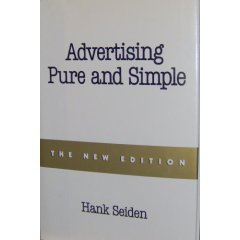
Hank Seiden
Hank Seiden, founding partner of my agency, passed away this week after a long battle with prostate cancer.
The memorial service was on Friday, and many of the advertising luminaries of his era—Jerry Della Femina, Tony Isidore, Dick Tarlow—came to pay their respects.
Funerals in general being for the benefit of family and friends and not industry insiders, there wasn’t a lot of advertising talk in the service. But Hank had a number of strong beliefs about advertising, beliefs he was not shy about expressing in his columns and books.
Hank’s central belief was that strategy is more important than execution. In other words, a brilliant strategy will work even when couched in a crappy execution, but a crappy strategy cannot be saved even by the most brilliant execution.
Right or wrong, this was a peculiar stance for a creative director to take, and it put him, both metaphorically and often literally, on the client side of the table. It also earned him the scorn of many in the creative community—a scorn which he wore as a kind of badge of honor.
Hank was a copywriter by training and a creative director by title, but in truth he was really what we now call a planner. He was superb at helping his clients chart a course for where they should position their products vs. the competition, who they should talk to, and what these prospects would find persuasive. He was completely indifferent to the craft aspects of the process, whether out of true lack of interest or feigned, I’ll never know. And predictably, with every passing year, he grew further and further disengaged from what he dismissively called “the fun and games of the business.”
Hank was also a brilliant client handler, and he inspired intense loyalty from a lot of very senior client-side executives. After retiring from Jordan Case, he was able to draw on that loyalty to start what is now Seiden Advertising. I joined Seiden at Hank’s invitation in 2000, essentially to take over as Creative Director because he was finally ready to hang it up.
This was only fitting, I guess, because 26 years previously, Hank had also been my first boss in advertising, at Hicks & Greist. I was there for little over a year, but learned a huge amount from him. There’s no doubt that a lot of my bedrock beliefs about communication were formed during that time.
A lot of what I learned from Hank I’ve since unlearned. I think craft is holy. I think strategy doesn’t matter in a lot of categories, and I think bad execution can ruin a smart strategy.
But, hey, everyone has to start somewhere. I started with a guy who knew a real idea when he saw it, and saw past the smoke and mirrors that still occasionally blind us.
And for that, I’ll always be grateful.
Time well spent

This is the Whole Earth Catalog.
It came out in 1969.
Printed on newsprint, in hot type and black ink.
It is an instruction manual for the world we have just begun to live in.
The subtitle is “Access to tools.”
A line that would work today for Charles Schwab, Williams-Sonoma, Adobe.
The Whole Earth Catalog contained some of the earliest references to:
Composters
Solar heating
Dry wall screws
accupressure
and a bunch of other stuff you can now get down at the mall.
It was embraced by people who viewed commerce with contempt, who mistrusted the Man. who were both deeply idealistic and reflexively cynical.
They pored over it, learned from it–and bought things from it. Lots and lots of things.
If you make ads, you could do worse than spending some time with the Whole Earth Catalog. You can find it, cheap in digital form, not so cheap in analog, on its direct descendant, the internet.
Totally authentic bullshit.

In this week’s Adweek, someone named Kamau High wrote a nonsensical piece entitled “Six Trends You Should Know.” Trend #1: Authenticity.
The idea of authenticity as a fashion is so richly ironic and so sad, because it suggests that the author (and most of his readers) have no fucking idea of what authenticity is.
Authenticity is not a trend. It is the result of not knowing or not caring about trends. It’s a Carrhart barn jacket on a farmer, not on a hipster. It’s barbecue in the Texas hill country, not at Hill Country. It’s the Paris in France, not the one at Epcot.
The greatest thing ever written about authenticity–what it is, and why it matters–is Julian Barnes’ novel England, England. Read it. You won’t be sorry. Then continue on with Mr. High’s article on 2008 trends.
Trend #2: Faux Traditionalism.
New Year’s Resolutions
Find nicer ways to say no to clients.
Find more occasions to say yes to clients.
Use less stock photography, or at least use it differently.
Dress better in the office. It suggests to people that I have my shit together.
Don’t just network when I want something.
Go 100% pun-free.
Make an ad that works on a 2 inch screen.
Be the same person on the business that I was during the pitch.
Re-read Ernie Schenck’s essay in the current CA at least once a month to keep my head from journeying too far up my ass.

In America, anyone can advertise whenever they want.

I watched the Las Vegas Democratic debate Thursday night, start to finish (and an odd finish it was, going out on the inane diamonds-or-pearls question), but nothing the candidates said could match the accompanying ads for highlighting this country’s weirdness.
I’m not sure if this was somebody’s idea of a joke, but one of the big advertisers was Clean Coal USA, which if you wipe away the light, airy, blue sky art direction, is the same grimy coal industry it’s always been.
That’s right. America’s coal mine owners crawled out of Dick Cheney’s butt long enough to underwrite the Democratic Presidential candidates’ prime-time debate.
Am I missing something? Are all these candidates in the bag already? Have they cut their deal with Big Energy? (Say it isn’t so, Dennis!) Or are the mining interests playing some kind of deep game, hoping that the more Americans watch these people bloviate, the more they’ll be inclined to commit to Mitt?
Oh—there was also a jaw-droppingly cheap and bad :60 DR spot for some sort of CD video bible. It showed a white nuclear family smiling and hugging on the couch as they watched the faux-parchment pages flick by on their big ol’ flatscreen.
Somehow, I don’t think they were TIVOing the debate while they watched.

Meeting cute in the Obituary column
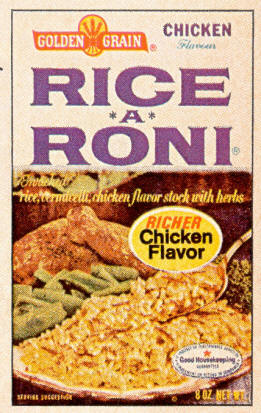 Died yesterday and reported in adjoining obituaries: Peg Bracken, author of the “I Hate to Cook” cookbook, and Vincent DeDomenico, creator of Rice-A-Roni.
Three years before Betty Friedan told ’60s women it was OK to be bored by kitchen duties, Bracken showed them how to short-circuit them with convenience foods. And a grateful food industry, Mr. DeDomenico, included, was right there to help.
Bracken, by the way, was an advertising copywriter. There’s a shocker. Her recipe for “Skid Row Stroganoff”:
Start cooking these noodles, first dropping a bouillon cube into the noodle water. Brown the garlic, onion and crumbled beef in the oil. Add the flour, salt, paprika and mushrooms, stir, and let it cook five minutes while you light a cigarette and stare sullenly at the sink.
 Belly of the Beast